
Immersive Retail Experiences: A Practical Guide for Brands
- David Bennett
- Jul 14
- 8 min read
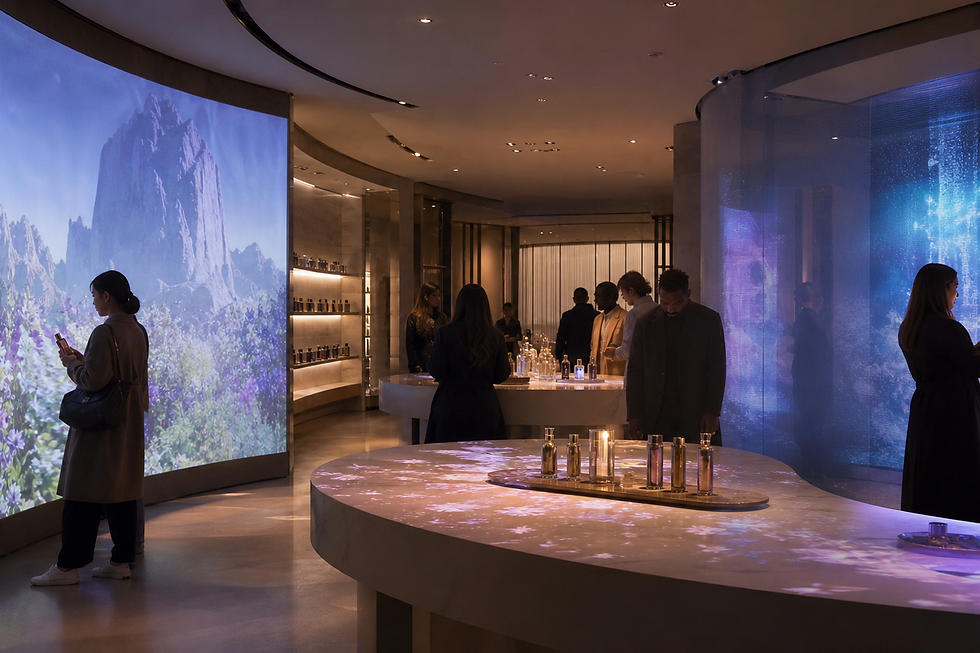
How can a physical store become a place customers choose to explore, not just pass through?
Immersive retail experiences combine physical products with responsive media, augmented reality, projection, sound, interaction, and spatial storytelling. They help brands turn a shop, flagship, pop-up, or showroom into an environment where discovery feels active and product benefits become easier to understand.
The goal is not to make every surface digital. It is to create a coherent journey that attracts attention, rewards curiosity, supports staff, and gives customers a memorable reason to engage. Done well, immersive retail can increase dwell time, clarify complex offers, strengthen launches, and connect in-store moments with useful next steps.
Table of Contents
What Makes an Immersive Retail Experience?

An immersive retail experience turns a store, pop-up, showroom, or shop-in-shop into a place where customers explore a brand through action. The environment does more than display products. It responds, reveals, guides, and gives people a reason to stay. Projection, augmented reality, interactive surfaces, spatial sound, sensors, AI avatars, and physical scenography can all contribute, but technology alone does not create immersion.
The defining quality is a coherent relationship between the customer, the product, and the space. A gesture might reveal how a material is made. Lifting an object might trigger a story. A wall-sized scene might place outdoor equipment inside the landscape it was designed for. An AR layer might show colour, scale, provenance, or styling without removing the tactile pleasure of the real product. Each interaction should answer a useful question or deepen a feeling.
That distinction matters because novelty fades quickly. A bright screen can attract attention, yet attention without meaning rarely changes behaviour. The strongest experiences create a simple loop: notice, understand, participate, and remember. They connect spectacle to product discovery and make it easy for staff to continue the conversation.
Retail immersion can also be quiet. Directional sound, responsive light, a subtle material animation, or a well-timed digital guide may be more effective than a room filled with screens. The scale should match the brand, location, customer, and decision being supported.
Mimic Immersive approaches this through immersive experience design for brand activations, combining spatial storytelling with practical interaction design. The same discipline that makes an event memorable can help a store become a repeatable brand environment rather than a one-off technology demo.
Design the Customer Journey Before the Technology

Immersive retail should begin with the customer journey, not a hardware list. Teams need to understand who is entering, what brought them there, how much time they have, what they already know, and what decision the experience should support. A flagship visitor may want discovery and entertainment. A busy shopper may need quick comparison. A pop-up guest may be motivated by exclusivity, participation, or access to a new release.
A useful journey often has five moments. Attraction makes the experience visible from a distance. Orientation explains what people can do without a long instruction panel. Exploration rewards touch, movement, or choice. Product connection links the experience back to real features and benefits. Continuation gives the visitor a next step, such as speaking with staff, saving a configuration, sharing a capture, booking a demonstration, or returning later.
The flow must work at different crowd levels. An interaction designed for one person can create a queue when ten people arrive together. A headset can provide deep presence but reduce throughput. Shared projection can serve groups, while personal AR can add detail. The correct mix depends on dwell time, staffing, accessibility, hygiene, reset speed, and the commercial rhythm of the store.
Teams should storyboard the experience from the threshold to the exit and test it with people who were not involved in the design. If visitors hesitate, miss a cue, or focus on the technology instead of the product, the journey needs simplification. The aim is confident discovery, not a puzzle.
The principles behind interactive installations for immersive brand experiences become practical retail decisions here. Every sensor, screen, avatar, and media layer should have a defined role. When the path is clear, the technology feels intuitive and staff can support it without becoming troubleshooters.
Blend AR, Projection, and Physical Products

Retail is powerful because customers can see, touch, try, compare, and discuss real products. Immersive technology should strengthen those advantages rather than replace them. The most convincing installations keep merchandise at the centre and use digital media to reveal context that is difficult to show on a shelf.
Augmented reality can add scale, variation, and explanation. A customer might preview a product in another environment, explore options that are not physically stocked, or see a layer of craftsmanship and provenance. Projection can transform a wall, table, fitting room, display window, or entire zone without asking every visitor to wear a device. Responsive media can follow movement, react to objects, or change with a curated product story.
For larger spaces, projection mapping for brand activations shows how architecture can become part of the narrative. In retail, that approach can turn a static department into a changing landscape, support seasonal storytelling, and make launches feel spatial without rebuilding the entire environment.
Restraint remains important. An AR overlay should not hide the object. Projection should not distort essential colour or material cues. Sound should add atmosphere without making conversation difficult. The experience should degrade gracefully if a customer chooses not to participate. Physical and digital layers should feel balanced.
Content should also reflect the real shopping context. A technology demonstration that looks impressive in a dark studio may disappear under retail lighting. Phone-based AR needs reliable tracking and a clear benefit. Displays must accommodate reflections, sight lines, cleaning, and product changes. Testing in the actual environment protects the creative idea.
Use Spatial Storytelling to Make Products Memorable

Products become more memorable when people understand the world around them. Spatial storytelling gives a retail experience a beginning, progression, and payoff. Instead of arranging disconnected interactive moments, the store guides visitors through a sequence that makes the brand promise easier to feel and repeat.
A story can be literal or atmospheric. A sustainability narrative might move from raw material to making, use, repair, and renewal. A mobility brand might let visitors travel from city congestion to a calmer connected journey. A beauty experience might shift through ingredient landscapes, texture, light, and personal expression. The objective is not theatre for its own sake; it is a structure that connects product detail with emotion.
This is closely related to immersive product launch experiences, where a reveal is strongest when the audience moves through a clear sequence. Retail extends that sequence over days, seasons, and repeat visits. Content therefore needs modularity: scenes can change, products can rotate, and interactions can evolve without replacing the system.
Good spatial stories leave room for choice. Customers should be able to skim, pause, or go deeper. Staff can use the environment as a conversation tool, while independent visitors can understand the core idea without assistance. That flexibility makes the story useful across discovery, education, launches, and consultation.
A consistent emotional rhythm is more important than constant intensity. Contrast creates memory: a calm orientation can lead to a dramatic reveal, followed by a focused product moment and a personal takeaway. When every zone competes for attention, customers stop knowing where to look.
Make Interaction Inclusive, Reliable, and Measurable

An immersive store only works when people feel comfortable joining in. If the experience requires confidence, perfect mobility, a specific device, or a long tutorial, many visitors will watch from the edge. Inclusive design treats participation as a spectrum and provides more than one way to engage.
Clear cues, generous response zones, reachable controls, captions where sound carries meaning, seated options, adjustable pacing, and staff-supported alternatives all improve access. Interactions should respond to ordinary gestures unless performance is the point. Personal data collection should be transparent and optional. Visitors should know when a camera or sensor is present and what happens to information.
Digital guides can reduce uncertainty. The article on AI avatars for brand activations explains how a character can welcome visitors, answer common questions, or suggest a route. In retail, an avatar should complement human staff and provide consistent orientation, not imitate a salesperson so aggressively that the interaction feels uncomfortable.
Immersive retail is also a live system, not a launch-day render. Projectors drift, sensors are blocked, networks change, content dates, and staff rotate. Operational planning must cover opening checks, calibration, safe shutdown, fault recovery, updates, cleaning, remote support, and a useful fallback state. A resilient installation still communicates the brand idea when one element is unavailable.
Production may combine real-time 3D, motion capture, animation, scanning, sound, physical fabrication, and software integration. Mimic Immersive’s XR, AI, and interactive installation services and technology capabilities can support that multidisciplinary pipeline. Clear ownership is essential: teams need to know who approves content, monitors performance, and resolves problems.
Measurement should connect interaction to the customer journey. Useful signals may include attraction rate, dwell time, completed interactions, product comparisons, staff handoffs, saved configurations, repeat visits, opt-in follow-ups, and qualitative feedback. Each metric needs a decision it can improve; data collection should never interrupt trust or emotional flow.
Media and systems built for a store can create reusable value across immersive event design, launches, social content, sales demonstrations, and touring installations. A modular platform allows campaigns to change while preserving the core investment. That is how a memorable environment becomes a maintainable business asset.
FAQ
What is an immersive retail experience?
It is a physical shopping environment enhanced by responsive storytelling and interaction. It may use AR, projection, spatial sound, sensors, interactive displays, AI avatars, or real-time 3D, but the defining feature is that customers actively explore rather than only view information.
How is immersive retail different from digital signage?
Digital signage primarily broadcasts content. Immersive retail connects media to space, products, and customer action. The environment may respond to movement, object handling, choices, or location, creating a two-way experience rather than a repeating screen loop.
Does immersive retail require VR headsets?
No. Shared projection, AR on familiar devices, interactive surfaces, spatial audio, and responsive lighting can often serve more visitors with less friction. VR is useful when full presence or simulation is essential, but it is one option within a wider toolkit.
Can immersive experiences work in a small pop-up?
Yes. A focused interaction, responsive product table, AR layer, digital character, or compact projection zone can create a strong experience in limited space. The idea and customer journey matter more than physical scale.
How early should the immersive team join a retail project?
Ideally during strategy and spatial planning. Early involvement helps align story, architecture, hardware, content, staffing, accessibility, power, networking, safety, and measurement before expensive decisions become fixed.
How can a brand avoid making the experience feel gimmicky?
Start with a real customer need or product truth. Use technology only when it improves understanding, emotion, access, personalization, or memory. Remove interactions that compete with merchandise or require explanation without meaningful value.
What should retailers measure?
Useful measures include attraction rate, dwell time, interaction completion, product exploration, staff handoffs, saved configurations, opt-in follow-ups, repeat visits, and customer feedback. Metrics should support decisions, not simply exist because sensors can collect them.
How do immersive installations stay reliable?
Reliability comes from venue testing, clear system ownership, opening and closing procedures, remote monitoring, simple recovery, staff training, modular content, spare components, and a graceful fallback state that preserves the core experience.
Conclusion
Immersive retail experiences are most effective when physical products, spatial story, and customer choice reinforce one another. The technology should make discovery clearer, participation easier, and the brand more memorable. When the journey is designed first and operations are planned from the start, a store can feel surprising without becoming confusing or fragile.
Mimic Immersive brings together XR, projection, interactive installations, AI avatars, real-time 3D, motion capture, and spatial storytelling for brand environments. Explore Mimic Immersive services or contact the studio to shape an immersive retail experience built around your audience, products, space, and measurable goals.


Comments